
Leon Foster · 11 September 2026
Navigating Evergreen Content Cycles for Solo Operated Web Properties in Competitive Niches
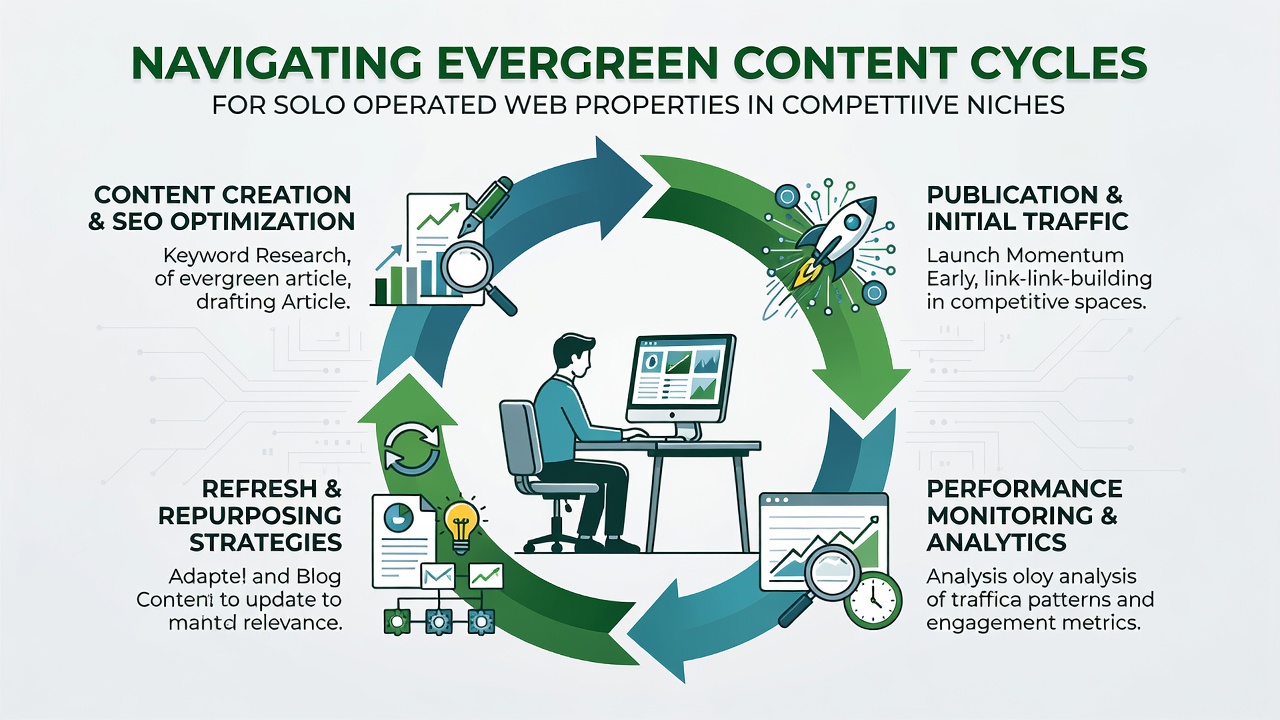
Evergreen content maintains relevance across extended periods while competitive niches demand consistent refinement to sustain visibility, and solo operators manage these demands without large teams by establishing systematic review processes that align with search behavior shifts. Data from multiple studies shows that pages updated at regular intervals retain higher rankings than static alternatives, yet the cycle involves more than simple rewrites because keyword trends, user intent, and competitor activity evolve simultaneously.
Identifying Core Evergreen Topics in Crowded Markets
Operators begin by mapping topics that demonstrate sustained search volume across years rather than seasonal spikes, and researchers have documented that queries related to foundational how-to guides or resource compilations often qualify when they address persistent user needs. In competitive niches such as software tutorials or health information, solo sites track term stability through tools that aggregate historical data, which reveals patterns where broad informational queries resist rapid obsolescence. One study from the Oxford Internet Institute examined web content longevity and found that pages incorporating primary data sources maintained traffic longer than those relying solely on secondary summaries, and this pattern holds because search engines prioritize demonstrated expertise signals.
Those who study niche dynamics note that evergreen status also depends on geographic and regulatory factors, so operators review compliance updates from bodies like the Australian Competition and Consumer Commission when content touches consumer advice topics. This step prevents sudden devaluations when rules change, and it integrates into the content cycle as a scheduled checkpoint rather than an afterthought.
Building Update Cadences That Fit Solo Workflows
Solo operators establish quarterly audits for core pages while reserving monthly checks for high-traffic assets, and this structure allows time for new data incorporation without disrupting daily operations. Evidence indicates that spreading revisions across smaller sessions prevents burnout, whereas batching everything into infrequent marathons leads to inconsistent quality. People who manage independent properties often integrate external data feeds into their calendars so that statistics from government sources refresh automatically, and this automation frees attention for deeper analysis of competitor movements.
During September 2026, several algorithm adjustments emphasized freshness metrics across informational queries, which prompted many solo sites to accelerate their review timelines by two weeks. Observers documented that properties which had pre-scheduled lightweight content audits adapted faster than those relying on reactive fixes, and the difference appeared most clearly in traffic retention rates for mid-tier keywords.
Balancing Original Research With Existing Knowledge Bases
Competitive niches reward sites that contribute novel datasets or case examples, yet solo creators achieve this by repurposing publicly available records into clearer formats rather than generating entirely new experiments. Academic reports from institutions such as the University of Toronto have shown that synthesized presentations of open government statistics attract steady backlinks when presented with clear visualizations and contextual explanations. Operators therefore allocate portions of each cycle to locating fresh primary sources, then integrate those findings into existing evergreen frameworks through targeted expansions rather than full rewrites.
Link acquisition follows a similar rhythm because authoritative references from regulatory agencies or research consortia strengthen topical authority over time. Solo properties that cite materials from the European Commission's digital strategy publications, for instance, often observe improved crawl frequency as search systems recognize consistent sourcing patterns. This approach avoids the resource drain of original studies while still meeting the evidence thresholds that competitive environments enforce.
Monitoring Performance Signals Without Dedicated Tools Teams
Performance tracking relies on free or low-cost analytics layers combined with manual review of key metrics such as dwell time and referral diversity, and operators set thresholds that trigger deeper investigations only when multiple indicators move together. Research indicates that isolated drops in one metric rarely signal content decay, whereas coordinated shifts across impressions, clicks, and engagement warrant attention. Those managing single-person sites therefore maintain simple spreadsheets that log monthly snapshots, allowing trend identification without complex dashboards.
External benchmarks from industry associations help contextualize internal numbers, and cross-referencing with reports issued by groups focused on digital publishing provides perspective on broader market movements. This comparative step keeps expectations realistic and highlights when niche-specific factors, rather than general algorithm changes, drive observed variations.
Conclusion
Solo operators sustain evergreen content in competitive niches through structured cycles that incorporate topic selection, scheduled revisions, source integration, and performance monitoring, and these elements work together because each addresses a different pressure point in the ecosystem. Data from varied regions continues to shape best practices, while timing adjustments around documented algorithm shifts such as those noted in September 2026 demonstrate how external events influence internal processes. The approach remains viable precisely because it scales with individual capacity rather than requiring constant expansion.